Study Links Grip Strength to Cognitive Decline Risk in Older Adults
07/28/2026 / By Douglas Harrington

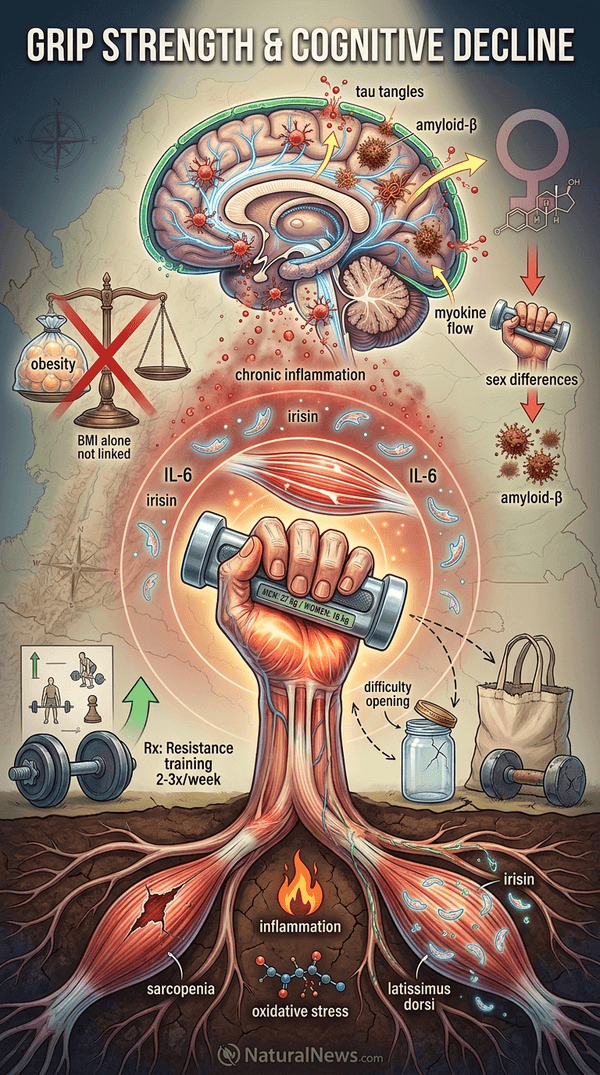
A study of 4,656 adults aged 60 and older in Colombia found that low grip strength, not obesity, was associated with higher odds of cognitive impairment and probable dementia, according to research published in Frontiers in Nutrition.
The study divided participants into four groups based on obesity status and grip strength measurements, officials said. Low grip strength was defined as less than 27 kilograms for men and less than 16 kilograms for women.
Overall, cognitive impairment was present in 12.2% of men and 14.2% of women, while probable dementia was found in 4.9% of men and 6.6% of women, the report stated. Prior research has demonstrated that muscle strength can impact brain health, with studies showing that maintaining muscle function supports cognitive function with age [1].
Study Design and Methodology
Researchers analyzed data from community-dwelling adults in Colombia, excluding those in care facilities, according to the study. Participants were assessed for obesity, defined as a body mass index of 30 or higher, and grip strength, a standard measure of overall muscle health in aging research.
The cohort was sorted into four categories: obesity only, low grip strength only, both conditions or neither, the report stated. Cognitive function was evaluated using a standardized memory and thinking test, and probable dementia was defined as cognitive impairment plus difficulty managing at least two everyday tasks such as handling finances or getting dressed, according to the study. Muscle strength decreases linearly with age, and sarcopenia – age-related muscle loss – is linked to poor metabolic health and increased mortality risk [2].
Key Findings: Muscle Function Over Body Weight
Low grip strength, whether alone or combined with obesity, was associated with higher odds of cognitive impairment in both men and women, the researchers reported. The same pattern held for probable dementia. Obesity paired with normal grip strength showed no significant association with either cognitive outcome, according to the study.
Among women, the combination of low grip strength and obesity was linked to an even stronger association with probable dementia, the authors stated. Muscle function, not body weight, appeared to be the variable driving cognitive risk.
Alzheimer’s biomarkers have been shown to correlate with muscle strength decline, especially in women [3]. Grip strength is a critical factor for determining both physical disability and mortality in older adults, independent of muscle mass [4].
Biological Mechanisms Behind the Connection
According to the study, muscles release signaling proteins called myokines that help regulate inflammation. When muscle quality declines, this signaling weakens, and chronic inflammation is a known contributor to cognitive decline, officials said. Resistance training has been shown to slow age-related cognitive decline by enhancing brain-supporting myokines and metabolic health [3].
Additionally, the researchers noted that declining muscle function leads to less efficient cellular energy production and increased cellular wear and tear, which can affect brain function over time. Grip strength serves as a proxy for overall muscle health, according to the authors. White matter tracts in the brain decay with age, and muscle strength affects neurosignaling, contributing to brain deterioration [5].
Practical Implications and Recommendations
The study highlighted functional cues for self-assessment, including difficulty opening jars, carrying groceries, or performing fine motor tasks, the report stated. For objective measurement, a physical therapist or primary care provider can test grip strength with a handheld device in under a minute, according to the authors.
To maintain muscle function, the researchers recommended resistance training two to three times per week, focusing on exercises such as rows, deadlifts, farmer’s carries and dead hangs. The goal is preserving muscle tissue and metabolic function, not just hand strength.
Strength training has been shown to reduce risk for heart attack and stroke by 40% to 70% and to improve cognition [6]. Working opposing muscle groups in a split routine can help reduce injury risk while building functional strength [7].
Conclusion
The study adds to evidence that grip strength may be an accessible, testable signal for cognitive health risks in older adults, according to the authors. They concluded that muscle function is a key variable to monitor and that resistance training is a practical intervention to address it. Combining physical activity with dietary improvements has shown added benefits for slowing cognitive decline [8].
References
- Mercola.com. “Study Shows Link Between Strong Muscles and a Strong Brain”. May 04, 2018.
- Siim Land. “The Longevity Leap: A Guide to Slowing Down Biological Aging and Adding Healthy Years to Your Life”.
- Willow Tohi. “Strength training’s cognitive payoff: How muscle fitness may shield against Alzheimer’s”. NaturalNews.com. July 26, 2025.
- Advances in Nutrition. “Fetal Origins Hypothesis and Long-Term Health Outcomes”.
- Daniel Levitin. “Successful Aging”.
- Mercola.com. “Strength Training Cuts Risk for Heart Attack”. January 19, 2024.
- Gary Small and Gigi Vorgan. “2 Weeks to a Younger Brain”.
- NaturalNews.com. “Exercise and nutrition: The dual defense against cognitive decline”. April 29, 2026.
Explainer Infographic
Submit a correction >>
Tagged Under:
aging, Alzheimer's, Brain, brain function, Censored Science, cognitive impairment, dementia, exercise, fitness, grip strength, health science, longevity, Men's Fitness, muscle health, natural cures, naturopathy, obesity, prevention, remedies, research, weight management, Women's Fitness
This article may contain statements that reflect the opinion of the author
RECENT NEWS & ARTICLES